Key takeaways
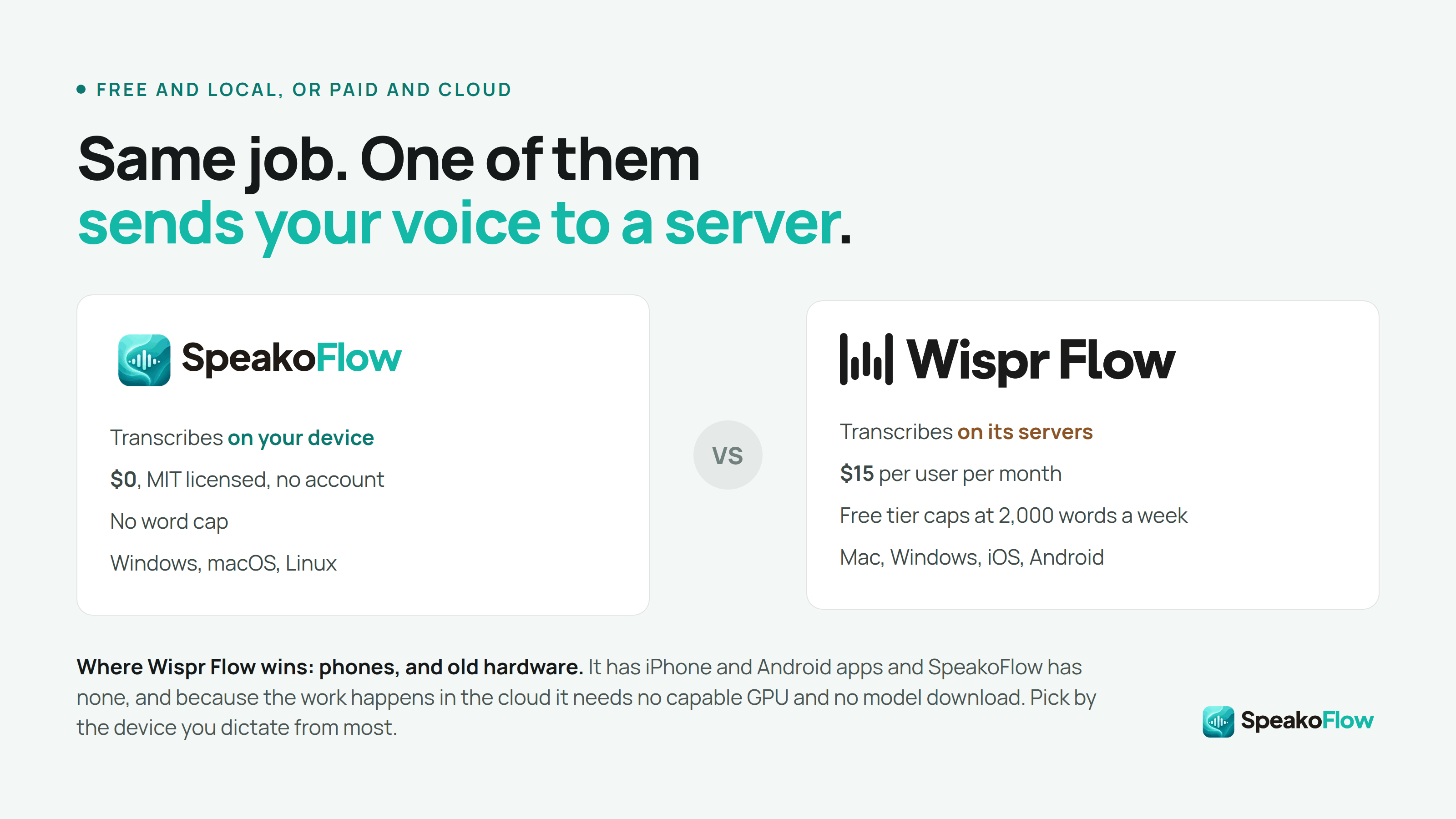
- SpeakoFlow is free and open source (MIT); Wispr Flow Pro is $15/month, or $12 per user per month billed annually ($144/year), after a 14-day Pro trial and a free tier capped at 2,000 words per week on desktop.
- SpeakoFlow transcribes on your device; Wispr Flow transcribes in the cloud. Only SpeakoFlow can run fully offline.
- SpeakoFlow runs on Windows, macOS, and Linux. Wispr Flow covers Mac, Windows, iPhone, and Android but not Linux.
- Wispr Flow is the more polished managed product with mobile apps; SpeakoFlow gives you control, privacy, and no subscription.
Disclosure: SpeakoFlow is our product, so read this as an informed comparison rather than a neutral review. Every Wispr Flow figure below is taken from Wispr Flow's own pricing and documentation and checked in August 2026, and the sections on offline use, platforms, and the verdict name the cases where Wispr Flow is the better buy. Where Wispr Flow fits you better, we say so.
Updated August 2026: re-checked against Wispr Flow’s pricing page. Since the July version, this comparison adds the 14-day Pro trial, the per-platform free-tier limits, the student and non-profit discounts, and the Enterprise compliance tier.
SpeakoFlow and Wispr Flow both let you press a key, speak, and drop finished text into any app. The difference that matters is architecture: SpeakoFlow is free, open source, and transcribes on your own device across Windows, macOS, and Linux, while Wispr Flow is a polished closed-source product that transcribes in the cloud and costs $15 per month after a limited free tier.
If you want the shortest answer: choose SpeakoFlow if free, private, and offline-capable matter most, or if you use Linux. Choose Wispr Flow if you want mobile apps and a fully managed cloud service and do not mind paying. The rest of this article backs that up point by point.
SpeakoFlow vs Wispr Flow at a glance
Here is the side-by-side, with every figure checked in August 2026. Pricing and plans can change, so verify current details on each product's site before deciding.
| SpeakoFlow | Wispr Flow | |
|---|---|---|
| Price | Free forever (MIT) | Free tier, then $15/mo or $144/yr |
| Free tier limit | No word cap | 2,000 words/week desktop, 1,000 on iPhone, unlimited on Android (limited time) |
| Free trial | Not needed — free forever | 14 days of Pro, no card required |
| Transcription | On your device | Cloud only |
| Works offline | Yes | No |
| Open source | Yes (MIT) | No |
| Account required | No | Yes |
| Platforms | Windows, macOS, Linux | Mac, Windows, iOS, Android |
| Bring your own model | Yes (local or your own key) | No |
Price: free forever vs $15 a month
SpeakoFlow is free forever under the MIT license, with no word caps and no account. Wispr Flow's free plan is limited to 2,000 words per week on desktop, roughly 15 to 20 minutes of speech, with 1,000 words per week on iPhone and unlimited words on Android. Unlimited use costs $15 per user per month, or $12 per user per month billed annually ($144 per year). Students and educators with an education email get 50% off Pro, and Wispr Flow says it discounts Pro for non-profits as well. Over three years, Wispr Flow Pro adds up to about $432 on the annual plan; SpeakoFlow stays at $0. Every figure here was read off Wispr Flow's own pricing page on 19 August 2026, and the full pricing breakdown covers what the free tier does and does not include.
That does not automatically make SpeakoFlow "better value" for everyone, because value depends on what you need. But if the recurring cost or the weekly cap is what pushed you to compare them, SpeakoFlow removes both. There is nothing to subscribe to and nothing to run out of.
Three-year cost of ownership
License and subscription fees only, for one user. Checked August 2026.
monthly $540
annual $432
Wispr Flow Pro is $15 per month month-to-month ($540 over three years) or $144 per year ($432 over three years). SpeakoFlow has no licence fee at any point. If you run the assistant against a cloud provider instead of a local model, you pay that provider directly at their rates; run it fully local and the total stays $0.
On price the gap is not close: SpeakoFlow costs nothing indefinitely, while Wispr Flow Pro runs $432 to $540 over three years depending on billing. The honest caveat is that a subscription buys you a support team and mobile apps, which SpeakoFlow does not have.
Privacy: on-device vs cloud
SpeakoFlow transcribes speech on your own machine, so your audio is never uploaded, and it collects no telemetry and requires no account. Wispr Flow's transcription always runs in the cloud, which means your audio is sent to its servers; it does offer a Privacy Mode that avoids retaining data, but the audio still leaves your device to be processed.
This is the deciding factor for many developers and writers, because prompts and drafts often contain source code, client details, or unpublished work. As we cover in our guide to voice dictation for AI prompting, if the text you dictate is worth protecting, the voice that dictates it is too. Because SpeakoFlow is open source, you can also verify these privacy claims rather than take them on faith.
The simplest privacy test is a question: does my audio have to leave this machine? For SpeakoFlow the answer is no.
SpeakoFlow's transcription never leaves your machine and you can read the code that proves it. Wispr Flow's Privacy Mode limits retention but the audio is still uploaded to be processed. If your rule is "audio must not leave this device," only one of the two can satisfy it.
Offline use and platforms
SpeakoFlow can run entirely offline using a built-in local model, so dictation works on a plane, on a locked-down network, or anywhere without internet. Wispr Flow needs a connection because its transcription is cloud-based; no internet means no dictation. If offline capability matters to you, this alone settles it.
Platforms differ too. SpeakoFlow covers Windows, macOS, and Linux, which makes it one of the few polished options for Linux users. Wispr Flow covers Mac, Windows, iPhone, and Android, so it wins if you need dictation on your phone but is unavailable on Linux. Match the tool to the machines you actually use.
This section splits the decision cleanly. SpeakoFlow is the only one of the two that works on Linux or with no internet. Wispr Flow is the only one of the two that works on a phone. Neither covers both, so pick by the device you dictate from most. If the network question is the one you came for, whether Wispr Flow works offline answers it against Wispr Flow's own documentation.
Features: dictation and beyond
Both tools do fast, system-wide dictation into any text field, and both offer AI cleanup that removes filler and fixes grammar. Wispr Flow adds mobile keyboards, team features, and a command mode for editing, backed by a dedicated support team, which is part of what the subscription pays for.
SpeakoFlow extends dictation in a different direction. Generate with Flow turns a spoken request into finished writing that is pasted for you; it can translate speech into English as you type; and a hotkey-summoned assistant answers by voice and can look at your screen when asked, with optional local memory. You can also bring your own model, running fully local or connecting a cloud provider with your own API key.
In short: Wispr Flow invests in polish and mobile reach; SpeakoFlow invests in control, privacy, and doing more than transcription on the desktop.
Where SpeakoFlow wins
- Free forever, no word cap, no account
- Transcription runs on your device, verifiable in source
- Works with no internet at all
- Runs on Linux as well as Windows and macOS
- Generate with Flow, translation, and a screen-aware assistant
- Bring your own model, local or your own API key
Where Wispr Flow wins
- iPhone and Android apps; SpeakoFlow is desktop only
- A dedicated support team rather than a GitHub issue tracker
- Longer track record and a larger user base
- Team and billing features, plus an Enterprise tier with SOC 2 Type II, ISO 27001, enforced HIPAA, and SSO/SAML
- Discounts for students, educators, and non-profits
- Nothing to configure: no model choice, no local setup
- Command mode for voice-driven editing
Which one should you choose?
Six situations cover most people comparing these two. Find yours rather than reading the whole comparison again.
- You use Linux
- SpeakoFlow. Wispr Flow does not support Linux at all, so this decides itself.
- You dictate on a phone
- Wispr Flow. It has iPhone and Android apps. SpeakoFlow is desktop only and there is no mobile version planned.
- Your audio must not leave your machine
- SpeakoFlow. Transcription is local by architecture, not by a setting you can forget to enable.
- You dictate offline — flights, locked-down networks
- SpeakoFlow. Wispr Flow needs a connection for every transcription.
- You want zero setup and someone to email when it breaks
- Wispr Flow. The subscription buys a managed product and a support team. SpeakoFlow's support is GitHub issues.
- You want more than transcription on the desktop
- SpeakoFlow. Generate with Flow, on-device translation, and a screen-aware assistant have no Wispr Flow equivalent.
The verdict
Choose SpeakoFlow if you want a free, open-source tool that keeps your voice on your machine, works offline, runs on Linux as well as Windows and macOS, and does more than dictation. Choose Wispr Flow if you need iPhone or Android apps, want a fully managed cloud product with dedicated support, and are comfortable with a subscription and cloud transcription.
For a broader view, including other free tools, see our roundup of the best free and open-source Wispr Flow alternatives. If your main use is talking to AI tools, the voice dictation for AI prompting guide goes deeper on that workflow.
Frequently asked questions
These are the questions the comparison above does not answer. The differences in price, privacy, and platforms are covered in the sections above.
Can I run SpeakoFlow and Wispr Flow at the same time?
Yes. They are separate desktop applications and neither replaces your keyboard, so you can keep both installed while you decide. The only thing to watch is the hotkey: give each tool its own shortcut so one does not swallow the other's key press. SpeakoFlow's transcribe shortcut defaults to Left Ctrl + Left Super and is reassignable in Settings.
Is on-device transcription as accurate as Wispr Flow's cloud?
It depends on which model you run, and that choice is the real difference. SpeakoFlow ships several families: Parakeet for fast everyday dictation, Nemotron streaming for real-time multilingual, and Whisper Small through Large for the widest accuracy. Larger models are more accurate and need more compute. Wispr Flow does not expose that trade-off because it picks for you on its servers, so you get consistent results without control over them.
Does SpeakoFlow need a powerful computer?
It uses your GPU when one is available and falls back to CPU otherwise, with Metal on macOS, Vulkan on Windows, and OpenBLAS plus Vulkan on Linux. On a modest machine you can run a smaller model such as Parakeet or Whisper Small instead of Whisper Large. This is a genuine advantage for Wispr Flow: because it transcribes in the cloud, your hardware barely matters. If you are on a very old or very low-powered laptop, that is a real reason to prefer it.
How does SpeakoFlow handle names and technical jargon?
Through a Custom words list, which is where you add terms a general model spells phonetically: product names, jargon, and personal names. It is especially useful for non-Western names, including Nepali and Indian names that English-first models tend to mangle. Pair Custom words with a Whisper model for the strongest results on mixed or non-English speech.
How many languages does SpeakoFlow support?
It depends on the model. Whisper Medium and Large cover close to 100 languages, Nemotron streaming handles 28 in real time, and Parakeet V3 and Canary cover 25 European languages. SpeakoFlow can also translate speech into English as you dictate, on your own device, with translation-capable models including Whisper, Canary, and Cohere.
When is Wispr Flow the better choice?
When you need dictation on an iPhone or Android device, when you want a managed product with a support team rather than a GitHub issue tracker, when your machine is too old to run a local model comfortably, or when you would rather not choose a model at all. SpeakoFlow focuses on the desktop across Windows, macOS, and Linux and asks you to make a few decisions in exchange for control.
Try the free, local one.
SpeakoFlow is free, open source, and keeps your voice on your machine, on Windows, macOS, and Linux.
Windows, macOS, and Linux. MIT licensed. No account, no telemetry.