Key takeaways
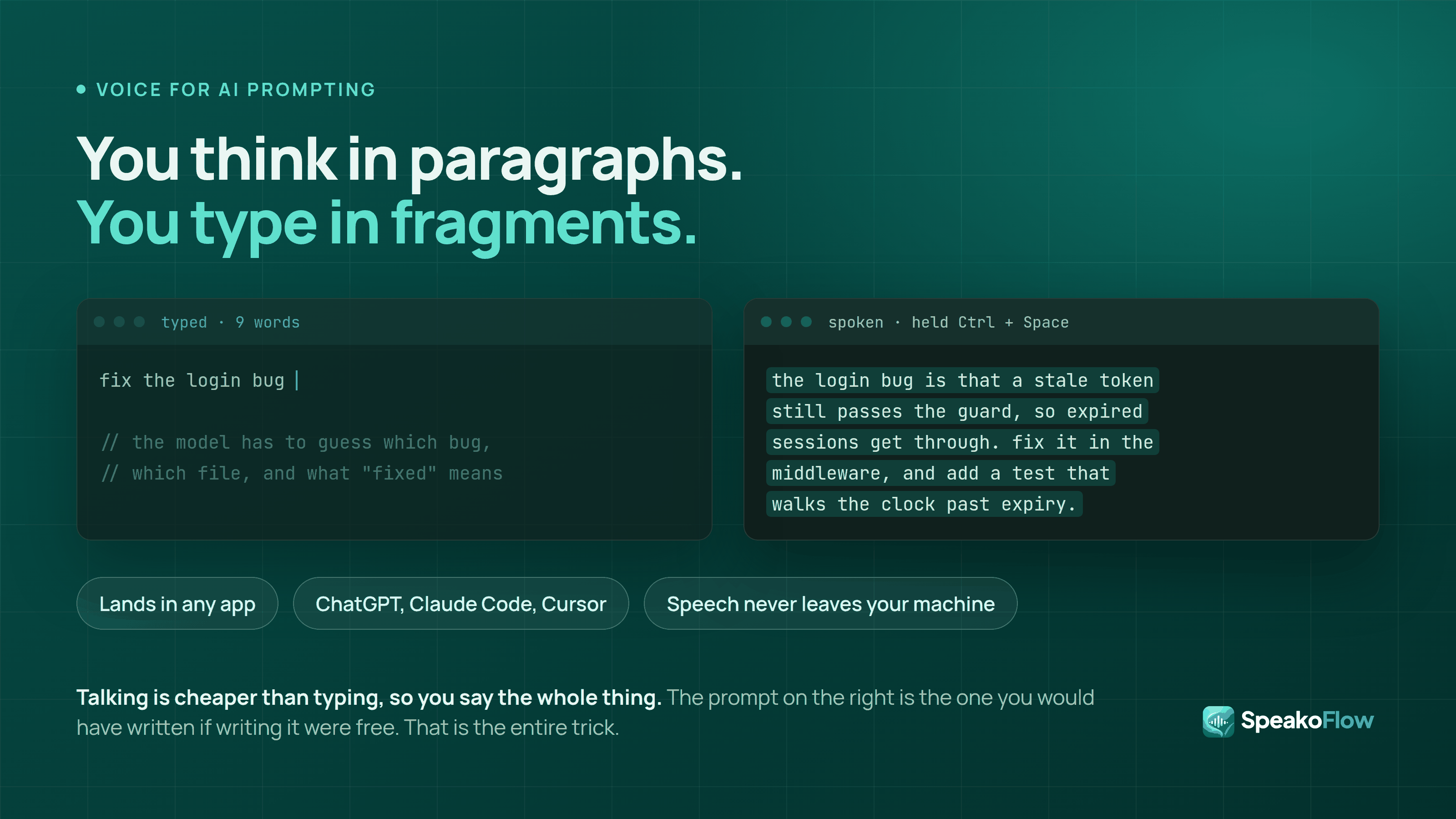
- Most people speak around 150 words per minute and type around 45, so dictating a prompt is roughly three times faster.
- Detailed prompts get better answers, and speaking lets you include the goal, constraints, and edge cases in one pass.
- The overlooked risk is privacy: your prompts often contain source code or client details, and most cloud dictation tools upload your audio.
- SpeakoFlow dictates into any app, including Cursor, VS Code, the terminal, and ChatGPT in a browser, and transcribes on your own machine. It is free and open source.
Disclosure: SpeakoFlow is our product. The workflow described here works with any system-wide dictation tool; we use SpeakoFlow as the example because we built it and can describe it accurately. Where a cloud tool would serve you better, the FAQ says so.
There is a quiet tax on working with AI tools: the better your prompt, the better the answer, but typing a good prompt is slow. So most of us compress. We drop the constraints, skip the edge cases, and paste a half-formed request because writing the full one by hand is tedious. Then we spend three follow-up messages adding back the detail we left out.
Voice removes that tax. When you can talk, giving the whole picture costs about the same effort as giving a fragment, so you stop compressing. This guide is about doing that well, into the tools you already prompt in, and doing it without handing your words to a third party.
Why voice fits AI prompting so well
The case is mostly arithmetic. Comfortable speech runs around 150 words per minute; steady typing sits closer to 45. That gap barely matters for a one-line search, but prompts are not one-liners. A good prompt to a coding agent describes the goal, the constraints, the files involved, and the thing you have already tried. Typed, that is a paragraph you will trim. Spoken, it is fifteen seconds.
The win is not typing speed, it is that you stop compressing. When a full prompt costs the same effort as a fragment, you include the constraints and edge cases you would otherwise have trimmed — and that is what actually changes the answer you get back.
Speaking does not just type faster. It changes what you are willing to say, because saying more no longer costs more.
This is why dictation and AI prompting have grown up together. The point is not raw transcription speed; it is that voice lets you hand the model the full context in a single pass instead of rationing it keystroke by keystroke.
Where you actually prompt: any field, one hotkey
The tools people prompt in are scattered: a browser tab for ChatGPT or Claude, an editor like Cursor or VS Code, a terminal running an agent, a chat window for quick questions. A dictation tool is only useful for prompting if it works in all of them without copy-paste.
SpeakoFlow types into whatever field your cursor is in. Press the hotkey (Left Ctrl + Left Super by default), speak, and the finished text lands right there, whether that is a Cursor prompt box, a terminal, a Slack thread, or a Google Docs page. There is nothing to switch to and nothing to paste back.
Two ways it lands. In transcription mode the finished text drops in when you stop talking. In live mode a floating card shows each word as you speak, so you can watch a long prompt take shape before it commits.
Beyond transcription: shape the prompt as you speak
Raw speech makes a rough prompt. You restart sentences, you say “um,” you think out loud. Two SpeakoFlow features turn that into something you would actually send:
- AI cleanup strips the filler, fixes grammar, and can reshape a rambling take into a tone you pick. What you meant survives; the mess does not.
- Generate with Flow goes a step further. Begin a dictation with “Hey Flow” and the rest becomes an instruction rather than literal text. Say “Hey Flow, write a prompt asking a coding agent to refactor this function for readability and add tests,” and Flow drafts the finished prompt and pastes it where you are working.
The result is that voice is not just a faster keyboard here. It is a way to go from a spoken thought to a well-formed prompt in one move.
The part nobody mentions: your prompts are sensitive
Prompts to AI tools are not small talk. They contain the function you are debugging, the client's data model, the internal document you are summarizing, the email you have not sent yet. When you dictate that, the question of where your voice goes stops being academic.
Most polished dictation tools are cloud services: your audio is streamed to their servers to be transcribed. For a shopping list, fine. For proprietary code or confidential data, that is a copy of your work leaving your machine every time you speak.
If your prompt is worth protecting, so is the voice that dictates it.
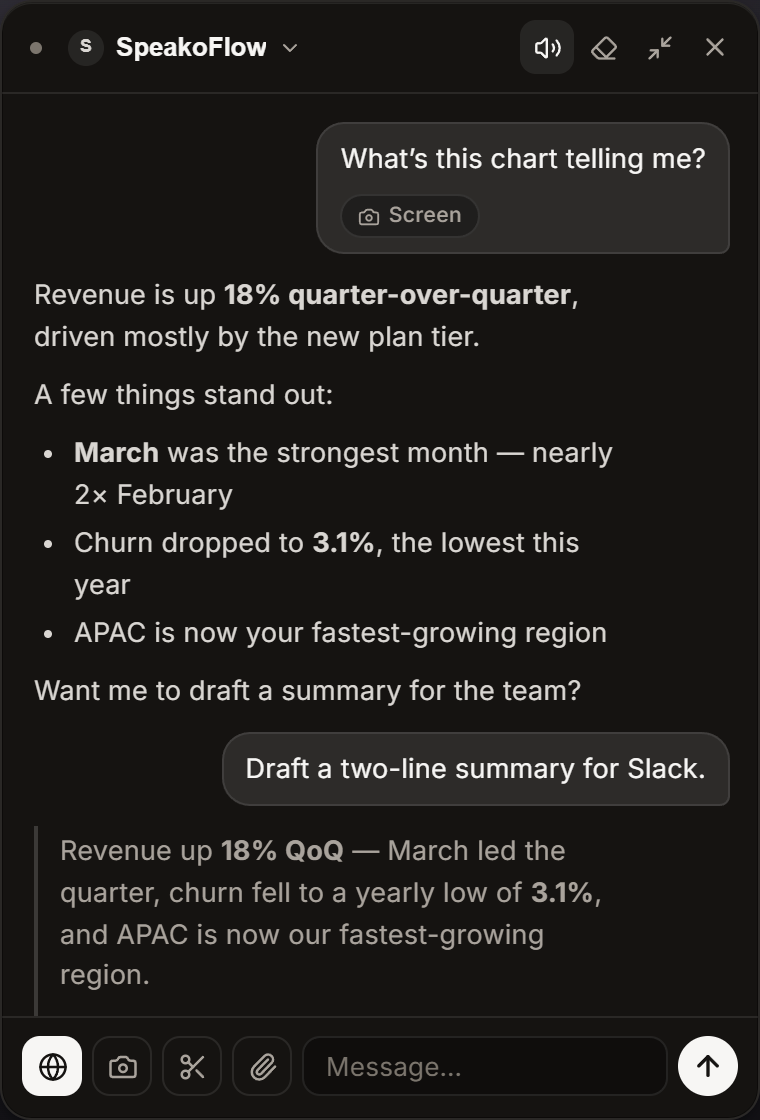
SpeakoFlow is built the other way around. Transcription runs on your own device, so your voice becomes text locally and is never uploaded. The assistant only ever contacts the model provider you choose, and that can be a fully local model, so you can keep the entire loop on your machine if you want to. There is no account and no telemetry.
Dictated prompts routinely contain source code, client data, and unpublished writing. A cloud dictation tool sends a copy of all of it to a third party every time you speak. If transcription runs locally, there is no copy to leak — and with an open-source tool you can check that claim in the source rather than trust it.
How to set it up for prompting
- Install SpeakoFlow on Windows, macOS, or Linux from the releases page. It is free and open source.
- Pick your model. Use the built-in offline model to stay fully local, point it at your own server, or add your own API key for a cloud provider.
- Learn the two hotkeys. Left Ctrl + Left Super dictates into any app; Left Ctrl + Left Alt summons the assistant. Both are configurable.
- Turn on AI cleanup if you want filler removed and grammar fixed before the text lands.
- Prompt by voice. Put your cursor in Cursor, a terminal, or a ChatGPT tab, hold the key, and describe the whole task. Say “Hey Flow” first when you want Flow to draft the prompt for you.
How it compares for prompting
| SpeakoFlow | Typical cloud dictation tool | |
|---|---|---|
| Where transcription runs | On your device | Their servers |
| Works in any app (Cursor, terminal, browser) | Yes | Usually |
| Drafts the prompt for you | Yes, with Generate with Flow | Rarely |
| Cost | $0, MIT licensed | Around $8–$30 / month |
| Free tier limit | No cap | Weekly word caps are common, e.g. 2,000/week |
| Account required | No | Usually |
| Platforms | Windows, macOS, Linux | Often macOS-first |
Frequently asked questions
Whether voice is faster, which apps it works in, and how the privacy model works are all covered above. These are the practical questions that come next.
Won't my dictated prompt be full of filler words and false starts?
It will be, unless you turn on AI cleanup, which strips filler, fixes punctuation and grammar, and can reshape a rambling take into a tone you choose — Concise and Professional being the useful ones for prompts. Cleanup is optional, off by default, and currently marked experimental. If you would rather send exactly what you said, leave it off.
How do I dictate code, file paths, and library names accurately?
Add them to the Custom words list. General speech models spell unfamiliar identifiers phonetically, so a list of your own product names, library names, and jargon fixes the same mistakes permanently. Pair it with a Whisper model, which handles unusual words and non-English names better than English-only models.
Should I use live mode or wait for the finished text when dictating prompts?
For prompts, transcription mode is usually better: you speak the whole request, stop, and the finished text lands at once, so you are not distracted by words appearing mid-thought. Live mode shows each word as you say it and suits note-taking. Live mode needs a streaming-capable model such as Nemotron streaming or Moonshine V2.
Is a cloud dictation tool ever the better choice for prompting?
Yes, in two cases. If your laptop is too old or too low-powered to run a local speech model comfortably, a cloud service does the compute for you and your hardware stops mattering. And if you prompt mainly from a phone, no fully local desktop tool helps — SpeakoFlow is desktop only. If neither applies, local transcription gives you the same speed without sending your prompts anywhere.
Do I need to pay or create an account?
No. SpeakoFlow is free and open source under the MIT license, with no account required. You can run entirely on the built-in local model, or connect your own cloud model with your own API key.
Prompt at the speed you think.
SpeakoFlow dictates into any app and keeps your voice on your machine. Free, open source, and yours to inspect.
Windows, macOS, and Linux. MIT licensed. No account, no telemetry.